How Hyundai Motor’s ambitious GBC project finally moved forward
Ten years on, auto giant’s vision for 105-story supertower has given way to more pragmatic three-tower complex
Following more than ten years of delays, redesigns and contentious negotiations, Hyundai Motor Group’s stalled headquarters project in southern Seoul has finally received the green light, reviving one of the city’s most ambitious urban redevelopment initiatives.
Seoul Metropolitan Government said Tuesday that it had finalized all negotiations with the carmaker on Dec. 30 for the construction of the Global Business Complex in Samseong-dong, southern Seoul, clearing the way for construction to resume.
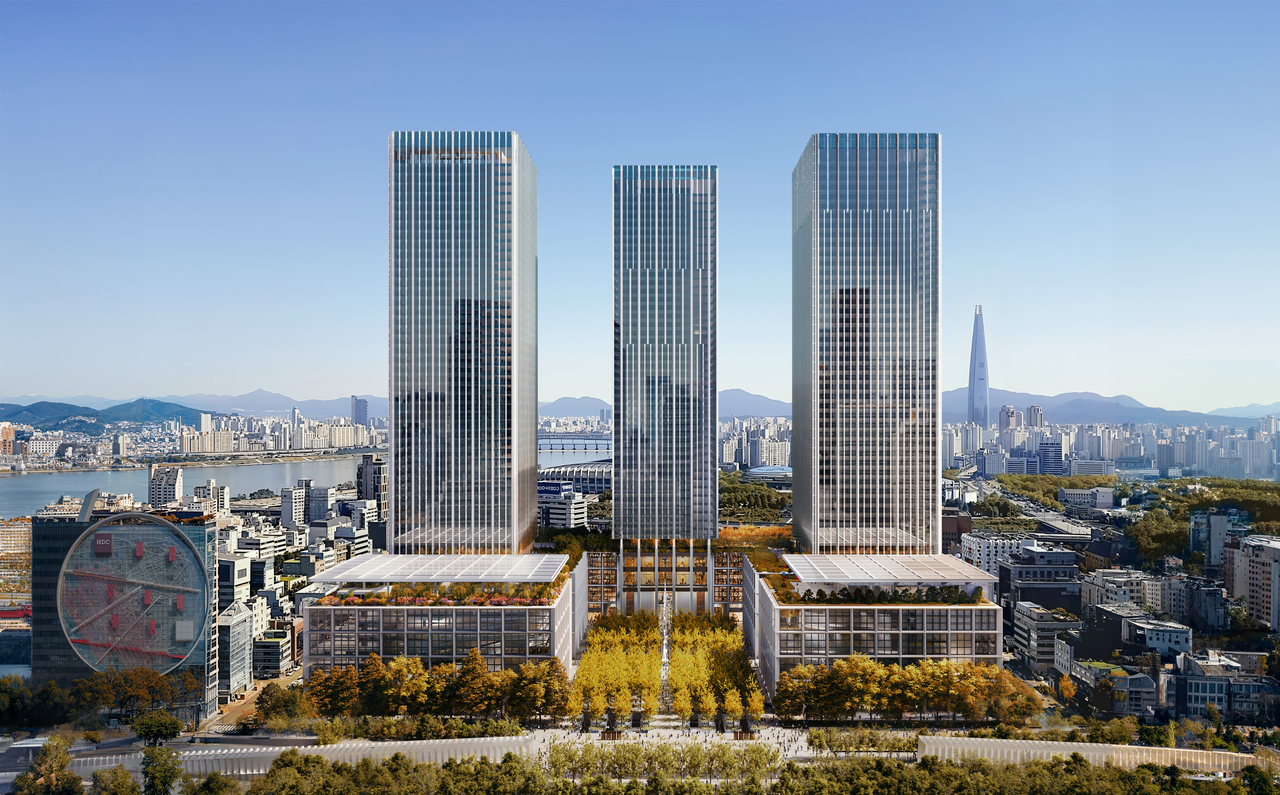
The plan was scaled back from an initial proposal for a towering 105-story building to three shorter 49-story towers, while Hyundai agreed to add an additional 233.6 billion won ($161 million) in a public contribution package. But final confirmation for the GBC, set for completion by 2031, could allow the long-idle plot in one of the city’s major commercial districts to at last move toward completion and bring long-awaited relief to the automaker.
Record-breaking land deal
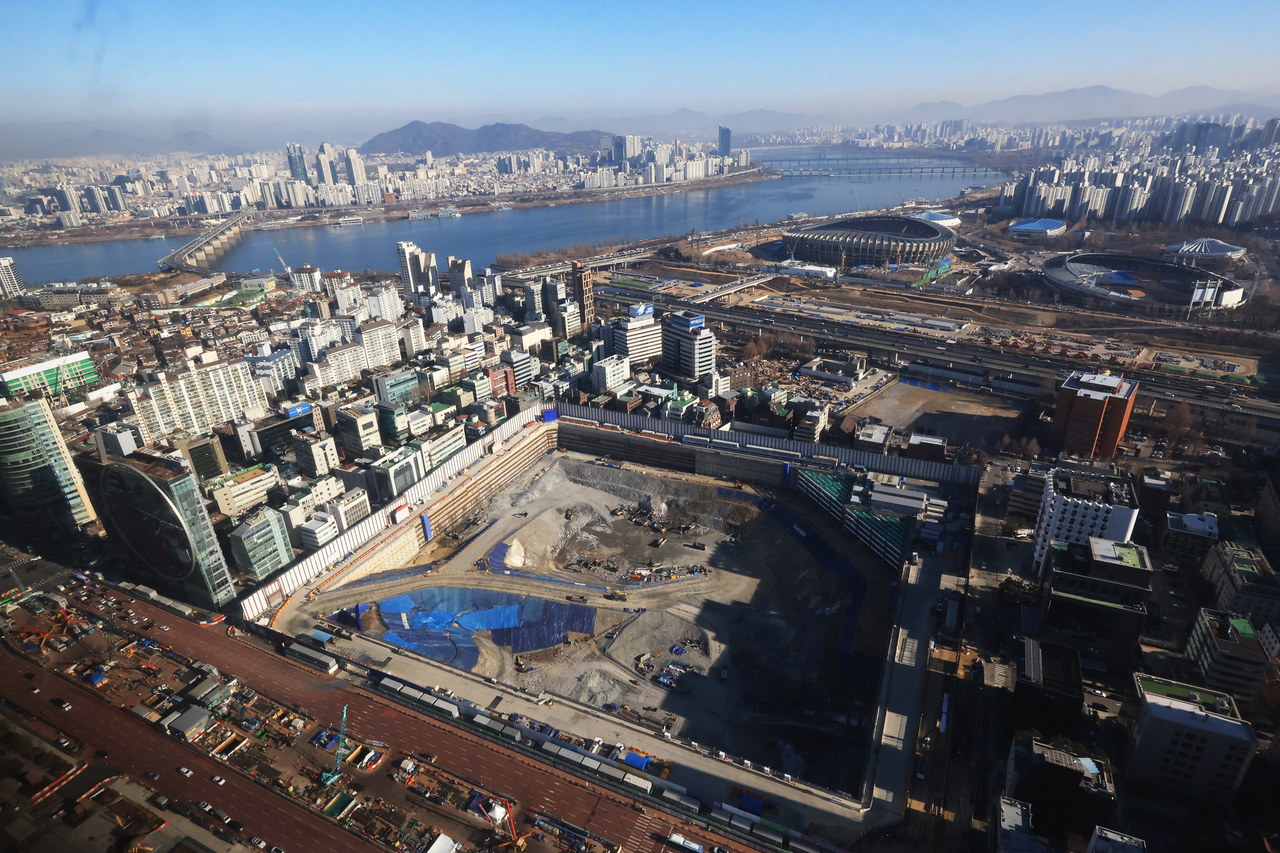
The GBC saga dates back to 2014, when the automotive conglomerate led by honorary chair Chung Mong-koo stunned the market by submitting a winning bid of 10.55 trillion won for the 79,345-square-meter parcel of land that housed the former headquarters of the state-run Korea Electric Power Corp., right across from Coex convention center.
At the time, the transaction set a record as South Korea’s most expensive real estate acquisition, unsettling investors. With the final price more than triple the appraised value, critics had feared the company was overspending to outbid rival Samsung Electronics, risking a winner’s curse rather than directing capital toward its core auto business or future technologies.
What the automaker at the time envisioned was a single, iconic 105-story landmark tower, housing its affiliates’ headquarters alongside offices, a hotel, convention center, observation deck and concert hall. Standing 569 meters tall, the skyscraper would have overtaken the 555-meter Lotte World Tower and claimed the title of the country’s tallest building.
In 2016, Hyundai and the Seoul government reached a preliminary agreement to proceed with the supertower project, and demolition of the existing Kepco building began.
The city granted zoning upgrades and floor-area-ratio incentives in exchange for roughly 1.7 trillion won in public contributions, designated for infrastructure projects in the Yeongdong-daero underground complex, the remodeling of Jamsil Stadium and the restoration of Tancheon and the Han River.
Public contributions refer to funds or physical infrastructure provided by a developer to local governments in return for relaxed urban planning regulations.
Military, religious-site setbacks
But the plan soon faced multiple roadblocks.
The military objected on national security grounds, arguing that the building’s massive height could interfere with radar systems used to detect aircraft or missiles. The matter was conditionally settled in 2019 when Hyundai decided to fund new radars for the Defense Ministry, but the prolonged consultations pushed back the timeline.
Another key hurdle came from Bongeunsa Temple, a historic Buddhist temple located directly across from the GBC site. From the outset, the temple fiercely opposed the original 105-story tower due to environment and ownership issues. It warned that the skyscraper would cast a massive shadow, blocking sunlight for most of the day at Bonggeunsa, home to many ancient wooden structures and national treasures, causing them to rot and decay over time.
There were large-scale protests by monks and believers, at times disrupting the environmental impact assessment hearings, which led to the project’s early delays.
Ownership issues further complicated matters. The Jogye Order of Korean Buddhism, which oversees the temple, filed a lawsuit alleging that the land had been forcibly seized from the temple in 1970. The legal dispute continued until late 2024, when the Supreme Court ruled in favor of the government and Hyundai.
While construction technically broke ground in May 2020, only initial excavation took place as negotiations with multiple stakeholders dragged on.
Shift away from supertall vision
On top of these conflicts, surging material and labor costs — compounded by the COVID-19 pandemic — weighed on Hyundai to rethink the feasibility of a supertall tower.
From 2020, speculation grew that Hyundai was ditching the 105-story plan in favor of several mid-rise towers due to cost concerns, security issues, technical complexity and questions over commercial viability. The shift became more pronounced after Chair Chung Euisun took the helm of the auto group in 2020, prioritizing practicality and investment in future technologies.
But it was Gangnam-gu that was against the changes, arguing that the 105-story tower was central to the area’s identity and long-term value, and that downsizing undermined the promised economic benefits and landmark status that justified the site’s regulatory concessions.
In 2024, Hyundai officially abandoned the supertall tower and submitted a revised proposal for two 55-story towers. Seoul city, however, initially rejected the revision, arguing that the public contributions and incentives were based on the 105-story tower, demanding a fresh round of negotiations. After further talks, Hyundai returned in February 2025 with a new proposal for three 54-story towers.
Following further talks, the two parties ultimately reached a compromise. The final plan calls for three towers that will be capped at 49 stories, each standing at 242 meters — below the 260-meter military restriction — thereby effectively resolving the radar issue.
Hyundai’s public contribution was increased to 1.98 trillion won, up from about 1.75 trillion won, marking the largest commitment of its kind tied to private development in the country.
Separately, Hyundai also agreed to fund additional transportation measures, including the expansion of Samseong Station and construction of a bus transfer center and several road improvement projects to ease congestion.
Industry observers say the project’s resumption could provide a significant boost to the economy at a time when South Korea’s construction sector remains in a prolonged downturn.
According to the Seoul city government, Hyundai is expected to inject around 5.24 trillion won in construction spending. The city expects GBC development will generate a total of 513 trillion won in economic value — 18 trillion won from the construction phase and 495 trillion won once operational — over a 26-year timeline, which includes one year for permits, five years for construction and 20 years of initial operations.
The project is expected to create around 1.46 million jobs over the long term and generate more than 70 trillion won in income effects.
“Through the additional negotiations, we have planned a new landmark that dramatically expands spaces for citizens, including a large urban park, exhibition and cultural facilities, and rooftop gardens, on a core site of the International Business District,” said Kim Chang-kyu, chief of the city’s balanced development bureau. “By accelerating a project that had been stalled for years, we aim to complete the GBC as a new engine of urban growth and a symbolic space representing Seoul.”
link