Inside the Winter Olympics: ASU students experience the gold standard of sports marketing in Milan
When Daniel McIntosh talks about the Olympic Games, he does not start with medals or podiums. He starts with planning, branding and experience.
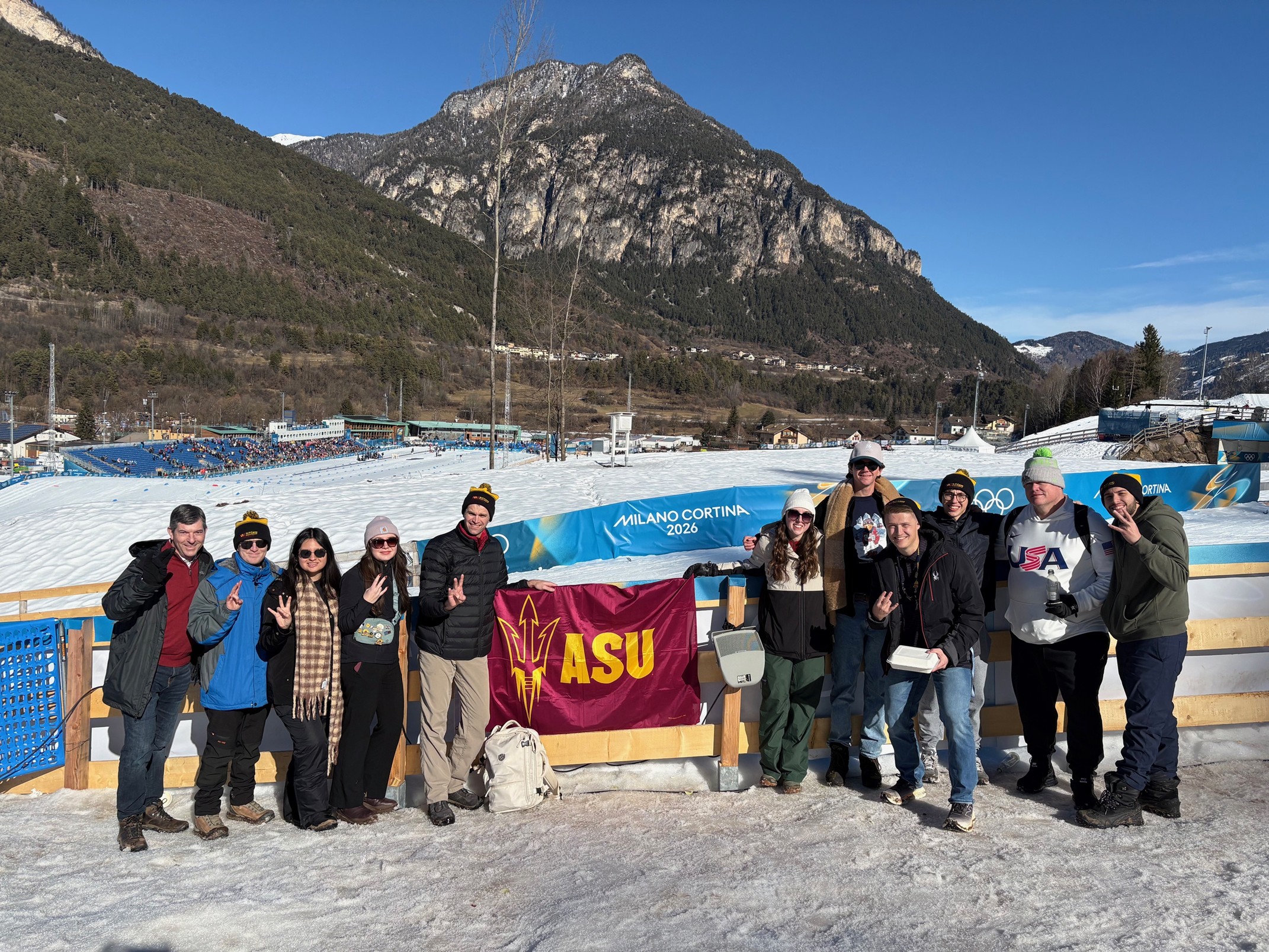
“This is a sports business trip where the classroom becomes the event itself,” said McIntosh, a teaching professor in the Department of Marketing at the W. P. Carey School of Business who is leading a group of 12 Arizona State University students to Milan, Italy, during the 2026 Winter Olympics.
“We are not just watching the Olympics. We are embedded in it, learning how the world’s biggest sporting event actually works.”
The Olympics started on Feb. 6 and ends on Feb. 22. The Milan Olympic study abroad group arrived in Italy on Saturday, Feb. 14, and will be there for five days.
The program is one of three global study abroad programs the W. P. Carey School offers this spring. It places students at the intersection of global sport, marketing strategy and real-time decision-making.
And the experience begins long before the group boards a plane.
As part of a for-credit academic program aligned with ASU’s sports business curriculum, the students focus on Olympic sponsorship, brand positioning and integrated marketing communications. Each one is assigned a major Olympic partner or governing body and arrives in Italy with weeks of research already completed.
Once on site, theory gives way to experience. Students attend two Olympic events and volunteer for two days at the USA Winter House, the U.S. Olympic and Paralympic Committee’s hospitality venue for athletes, families and partners. They are also meeting with eight to 10 executives from Olympic sponsors and partners — including Visa, Airbnb, Coca Cola, Allianz and NBC. NBC is hosting the group at the International Broadcast Center, offering a behind-the-scenes look at how the Games are delivered to billions of viewers worldwide.
“What makes this special is hearing executives explain their strategy while the activation is happening,” McIntosh said. “It is one thing to study a brand in a classroom. It is another thing to hear a senior executive explain why they are spending eight or nine figures on an Olympic partnership while you are standing in the middle of it.”
Rachel Lauer, a double-major in marketing and sports business, said the scale of the operation is what stands out most.
“I want to see how many people and how many years of effort go into making something like this happen,” Lauer said. “It is not just the sports; it is the sponsors, the partnerships and the logistics that people never really think about.”
That attention to detail is a theme McIntosh emphasizes repeatedly. He points to past Olympic and Super Bowl experiences where even the smallest elements were carefully planned.
“These events are so well executed that you only notice something when it goes wrong,” he said. “Our students get to see how much trust and planning goes into every single detail, from transportation to hospitality to brand imagery.”
Fourth-year sports business student Luz Campos Berumen is focused on the global nature of marketing and how messages translate across cultures. She is researching the U.S. Olympic and Paralympic Committee and examining how the organization builds its brand around athletes and experience rather than products.
“They are not selling merchandise in the same way as a company,” said Campos Berumen, who is a sports business scholar at ASU. “They are selling an experience and the stories of their athletes. I want to see how that comes to life with fans and sponsors in person.”
For Nathan Edlebeck, who is studying business law with a minor in Spanish, the Olympics represent something even larger.
“It is incredible to see how countries come together for this,” said Edlebeck, a fourth-year student. “Beyond the business and marketing, there is a global moment where competition and cooperation exist at the same time. Being there in person is a once-in-a-lifetime experience.”
Edlebeck has been researching the International Olympic Committee and is particularly interested in how corporate sponsorship connects to global viewership.
“You might not have millions of people in the stadiums,” he said. “But you have billions watching around the world. The marketing impact of that is massive, and it absolutely pays off.”
One of the most notable aspects of the Milan program is its inclusion of ASU Online students for the first time. Porter Farr, a fourth-year student majoring in sports business who lives in Utah, will join the group in Italy.
“When I saw this (opportunity), I knew I could not miss it. It is a huge resume builder and something I would regret forever if I did not go,” Farr said.
Farr’s participation represents a broader shift in access, McIntosh said.
“This is a new model for connecting online students to global experiential learning,” he said. “We are expanding who gets to have these high-impact experiences, and that is incredibly important to our mission.”
McIntosh hopes students return with more than photos and memories.
“We want them to understand how global sport really works,” he said. “If you want to be a leader in sports business, you need to see it at this level. There is simply no classroom big enough to teach the Olympics.”
link