Learning from Global Business Leaders
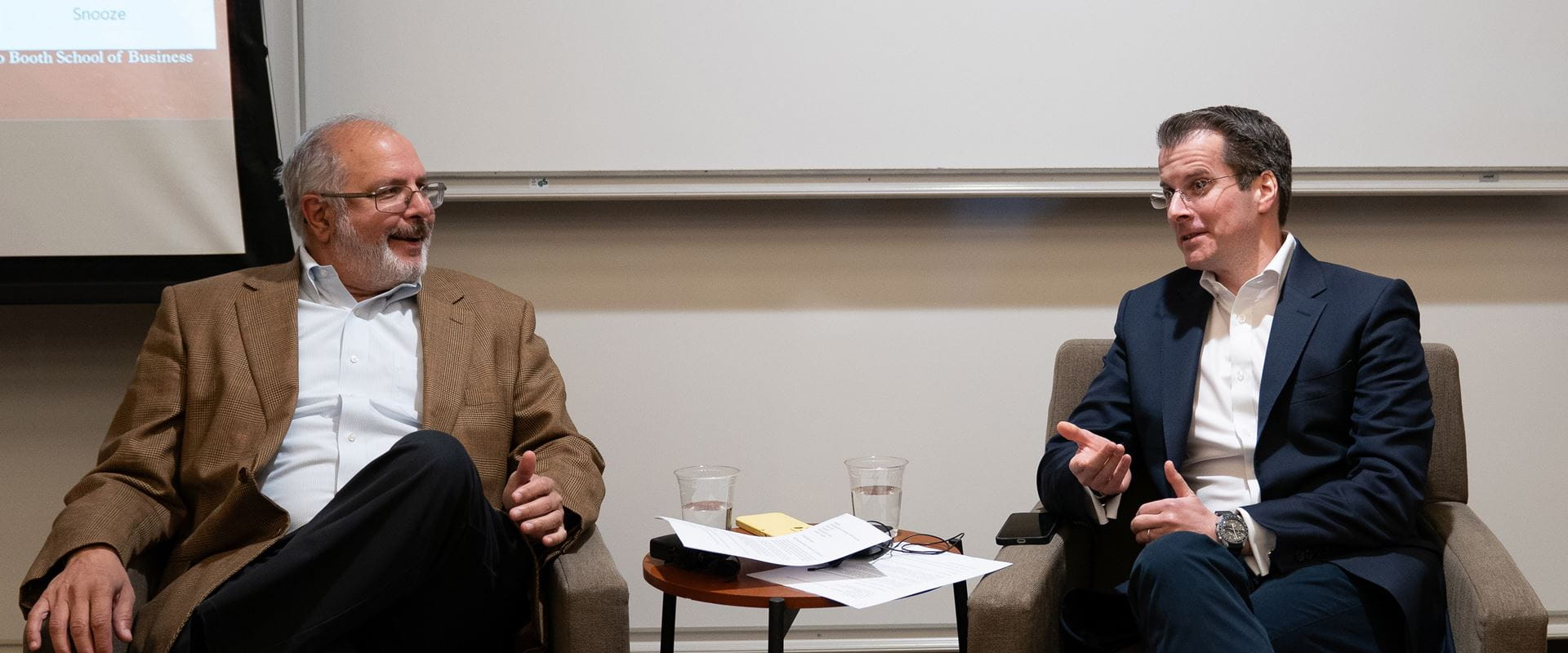

During the session, Mueller-Glissmann gave students an insider’s view of what it’s like to work at Goldman Sachs. He discussed the structure of his research team, the rhythms of day-to-day work, the demands of his globe-trotting role, and the broad approach the firm takes to investment.
Mueller-Glissmann also touched upon the transformational role of AI in his field. “AI is all about data and data ownership,” he said. “I think, ultimately, the companies with the most data will probably have enormous benefits for AI.” Because companies such as Goldman Sachs have massive amounts of proprietary data, Mueller-Glissmann added, “Enterprise AI will probably be a much bigger deal than consumer AI, over time.”
Along with emphasizing joy, Mueller-Glissmann stressed the importance of good communication skills. He shared an anecdote from early in his career when he thought he had nailed a presentation, only to learn from his boss that he came across as “cold” and “technical” and had largely lost the room.
That taught Mueller-Glissmann several valuable lessons: Learn how to have a meaningful conversation, simplify complex topics, and read whatever room you’re in. “Sometimes the best way to start a meeting is to ask questions,” he said. “What do they want to learn from you? How can you best address their needs?”
Mueller-Glissmann also advised students to build a portfolio of skills: Work to become the smartest person on one topic so you become the go-to resource. Then, work on the next topic, and so on. “Over time, you build a portfolio of knowledge that gives you the best scope to be successful,” he said.
At the end of the discussion, students had the opportunity to ask Mueller-Glissmann their own questions about the finance industry and global economy. They touched on the likelihood of a debt crisis, the role of AI in investment strategy, operating across time zones, domestic versus international investment options, and more.
Referencing the US government shutdown, one student asked about responding to potential macro shocks in the market. How do you position portfolios? What’s the framework?
“We try to build models and frameworks that allow us to analyze based on historical parallels and historical patterns,” Mueller-Glissmann said. “It always comes down to quantifying things, trying to benchmark macro data, and trying to add value.”
As the session closed, Mueller-Glissmann left Booth students with one final piece of advice: “This life and this job is all about growth. Never stop growing.”
link